
Key takeaways
- Compare five trinocular phase contrast microscopes with genuine phase objectives and camera ports, chosen for sharp microscopy photography of live cells.
Photographing living cells is a different purchase from simply viewing them. A scope can look fine through the eyepieces yet produce soft, uneven frames once a camera is attached, because phase rings, condenser alignment, and the photo port all shape the recorded image. The real decision is which phase system, camera path, and illumination setup will still satisfy you after the first month of shooting.
This guide serves lab staff, advanced students, and dedicated hobbyists who photograph unstained specimens such as cultured cells, pond organisms, and bacteria. Every pick below is a trinocular phase contrast laboratory microscope chosen from its listing details: the phase objectives named, the condenser arrangement, the camera included or the port provided, and the illumination fitted.
Quick Picks
As an Amazon Associate we earn from qualifying purchases.
| Product | Best for | Key spec |
|---|---|---|
| OMAX M8311Z-PHB3-C100U | Full phase range with a camera in the box | Four phase objectives, PH10X to PH100X oil |
| OMAX M8311Z-PHC2-C180U | High-resolution stills for documentation | 18MP USB 3.0 camera, 4912×3684 capture |
| AmScope T490A-PCT | Fast switching between contrast modes | Phase-contrast turret with four plan objectives |
| AmScope T490A-PCS | A first genuine phase scope on a tighter budget | Three phase objectives, 23mm and C-mount port |
| OMAX XM827PHB1 | Dedicated benches running both contrast systems | Five-position phase disk, plan phase objectives |
How to Choose
Match the Phase Objectives to Your Specimens
Phase contrast only exists at the objectives fitted with phase rings, so the objective list decides what you can photograph. A set running PH10X, PH20X, PH40X, and PH100X oil covers everything from scanning a culture flask to framing individual bacteria. A two-objective set such as PH10X and PH40X handles routine cell work well but leaves no phase option at 100X, which caps detailed stills at 1000X. Check the listing for each PH designation rather than trusting a headline magnification range, because brightfield figures often look larger than the phase figures on the same instrument.
Decide How the Condenser Handles Phase Annuli
Each phase objective needs a matching annulus in the condenser, and the mechanism affects every session. A rotating turret or a disk with switchable positions lets you change objectives and keep shooting, while interchangeable condensers demand a swap and fresh centering each time. Individually centerable annuli give the cleanest halo control for photography, since a slightly off-center ring shows up in images as uneven contrast across the frame. If you photograph several magnifications in one sitting, favor the system that keeps alignment stable while you work through them.
Plan the Camera Path Before You Buy
For microscopy photography, the trinocular port is only half of the imaging chain. Bundled cameras, such as the 10MP and 18MP USB models below, include reduction lenses and measuring software, so you can capture and annotate images immediately. Port-only scopes accept a 23mm tube or C-mount camera later, which suits buyers who already own an imager or want to choose one separately. Confirm what the listing includes: sensor size, connection type, and whether a calibration slide is bundled for scale bars in published frames.
Weigh Halogen Against LED Illumination
Halogen lamps in the 6V/20W class deliver bright, phase-friendly light and remain common on turret and disk systems, but they run warm and can stress living specimens during long photographic sessions. LED illumination, typically a 3W variable unit on the OMAX models here, runs cool and holds a steady intensity, which helps when you record time-lapse sequences of moving organisms. Either source works for stills; the deciding factors are session length, specimen sensitivity, and whether you accept bulb replacement as routine upkeep on a halogen instrument.
The 5 Best Options
OMAX M8311Z-PHB3-C100U Phase Contrast Trinocular Microscope

This OMAX suits photographers who want the widest phase coverage without assembling a system piece by piece. Four phase objectives reach from PH10X survey work to the PH100X oil lens for fine bacterial detail, and the bundled 10MP USB camera records stills and measurements from day one. Cool LED illumination protects living samples during longer sessions, and individually centerable annuli keep contrast even across the frame, which is exactly what recorded images demand.
Specs
- Phase contrast magnification: 100X-200X-250X-400X-500X-1000X-2500X
- Brightfield magnification: 40X-100X-250X-400X-1000X-2500X
- Phase objectives: PH10X, PH20X, PH40X (S), PH100X (S, Oil)
- Illumination: 3W LED, adjustable intensity
- Camera: 10MP (3584×2748) USB with 0.5X reduction lens
- Stage: X-Y mechanical, 78mm x 40mm travel range
- Five-year coverage against manufacturing defects
Best for: Photographers who need phase images at every magnification, including oil-immersion work, with a camera already included.
Watch out for: Full-resolution capture runs at only 1.9fps, so confirm you mainly shoot stills rather than smooth live video before ordering.
ASIN: B00UCEQAMQ — View on Amazon
OMAX M8311Z-PHC2-C180U Trinocular Microscope with 18MP Camera

Documentation drives this configuration. The 18MP USB 3.0 camera captures 4912×3684 frames and ships with a calibration slide plus measurement tools, so images can carry accurate scale information for reports and teaching material. Its two objectives are plan phase glass, which keeps the field flatter out to the edges than achromatic sets — a visible difference when a photograph, not an eyepiece view, is the final product. A darkfield condenser position adds a second contrast method for specimens that respond poorly to phase rings.
Specs
- Phase contrast magnification: 100X-250X-400X-1000X
- Brightfield magnification: 40X-100X-250X-400X-1000X-2500X
- Phase objectives: PLAN PH10X, PH40X (S)
- Condenser positions: darkfield, brightfield, PH10/20, PH40
- Camera: 18MP (4912×3684) USB 3.0 with 0.5X reduction lens
- Illumination: 3W LED, adjustable intensity
- Eyepieces: WF10X/18 and WF25X
Best for: Users whose priority is high-resolution, measurable stills for documentation and publication rather than maximum phase range.
Watch out for: There is no 100X phase objective, so check that your photography stays at or below 1000X in phase mode before choosing it.
ASIN: B01BPJIKAG — View on Amazon
AmScope T490A-PCT Trinocular Microscope with Phase-Contrast Turret
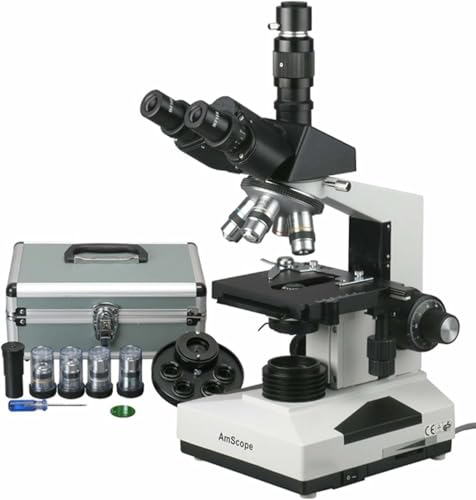
The T490A-PCT is built around a phase-contrast turret carrying four plan objectives, so moving between phase settings is a quick rotation instead of a condenser swap. That speed matters when a living specimen is changing while you work and you need frames at several magnifications before it moves on. The trinocular Siedentopf head inclines at 30 degrees and rotates a full circle, and the same instrument also handles brightfield and darkfield viewing, giving photographers three ways to render a transparent subject.
Specs
- Magnification range: 40X-1600X
- Phase objectives: Plan PH10X, PH20X, PH40X (S), PH100X (S, Oil)
- Illumination: Halogen with rheostat, 6V/20W
- Contrast modes: Brightfield, darkfield, phase contrast
- Condenser: 1.25 NA Abbe with iris diaphragm
- Eyepieces: WF10x and WF16x widefield pairs
- Head: Trinocular Siedentopf, 30-degree inclined, 360-degree rotatable
Best for: Photographers who switch between phase, brightfield, and darkfield on the same specimen and want turret-speed changes.
Watch out for: No camera is included, and the halogen lamp runs warm, so budget for a C-mount camera and consider session length with live cultures.
ASIN: B005LVVCSW — View on Amazon
AmScope T490A-PCS Trinocular Phase Contrast Microscope

The T490A-PCS is the honest entry point into genuine phase photography. Three phase plan objectives, including a PH100x oil lens, cover six phase magnifications, and the vertical trinocular port accepts 23mm or C-mount cameras whenever you are ready to add one. The package arrives complete with immersion oil, color filters, a spare bulb, and a dust cover, so nothing essential is missing on the first day. A double-layer mechanical stage with a stage stop protects slides and objectives while you hunt for the right field.
Specs
- Magnification range: 40X-1600X
- Phase objectives: PH10x (0.25), PH40x (0.65), PH100x (1.25)
- Illumination: Halogen 6V/20W with rheostat
- Contrast modes: Brightfield, phase contrast
- Condenser: 1.25 NA Abbe with iris diaphragm
- Eyepieces: WF10x and WF16x, 23mm
- Stage: Double-layer mechanical, 75mm x 45mm travel
Best for: Students, teaching labs, and hobbyists who want authentic phase contrast now and a camera upgrade path later.
Watch out for: Changing phase objectives means swapping condensers by hand, so verify you accept slower mode changes than a turret system.
ASIN: B005LVW2P4 — View on Amazon
OMAX XM827PHB1 Advanced Trinocular Phase Contrast Microscope

The XM827PHB1 keeps separate brightfield and phase contrast systems on one bench, with a phase disk offering five switchable positions matched to plan phase objectives from 10X through the 100X oil lens. Eight phase magnifications up to 1600X give photographers fine steps for framing organisms of very different sizes. The transmitted halogen source is the traditional choice for phase work, and the trinocular head carries the camera while both eyepieces stay available for focusing and composing the shot.
Specs
- Brightfield magnification: 40X-64X-100X-160X-400X-640X-1000X-1600X
- Phase contrast magnification: 100X-160X-200X-320X-400X-640X-1000X-1600X
- Eyepieces: WF10X/18 and P16X
- Objectives: Achromatic DIN 4X, 10X, 40X (S), 100X (S, Oil)
- Phase objectives: Plan 10X, 20X, 40X (S), 100X (S, Oil)
- Condenser: NA1.25 Abbe with iris diaphragm
- Illumination: Transmitted halogen, 6V 20W
Best for: Stationary laboratory benches that photograph varied specimens and want both contrast systems permanently set up.
Watch out for: The frame is heavy and bulky with many separate components, so confirm your bench space and setup patience before ordering.
ASIN: B004EC5EI8 — View on Amazon
Which One Fits Your Situation
You Photograph Living Cultures for Hours at a Time
Heat is your enemy, because a warm lamp slowly changes the behavior of the organisms in the frame. Choose one of the LED models: the OMAX M8311Z-PHB3-C100U if you also need the full phase range up to the 100X oil objective, or the M8311Z-PHC2-C180U if still resolution matters more. Both keep illumination cool and steady through long sessions, and both include their cameras, so the imaging chain is complete on arrival.
You Need Images for Reports, Classes, or Publication
Measured, high-resolution frames carry the day here. The OMAX M8311Z-PHC2-C180U pairs its 18MP USB 3.0 camera with a calibration slide and measurement software, and its plan phase objectives keep edges flat for print. If your subjects also need darkfield rendering, it covers that too. Accept its 1000X phase ceiling as the trade for the strongest documentation package in this group.
You Are Buying Your First Real Phase Scope
Begin with the AmScope T490A-PCS. It includes genuine phase objectives up to a 100X oil lens, arrives with oil, filters, and a spare bulb in the box, and leaves the camera decision for later through its 23mm and C-mount port. You give up turret convenience, not image quality, and the complete accessory set means your first photographic session needs no extra orders.
Your Bench Handles Many Different Specimens Daily
Variety rewards flexible contrast hardware. The AmScope T490A-PCT rotates between four plan phase objectives and adds darkfield, suiting benches that move between specimen types all day. If the workload leans toward photography at many magnifications on one fixed station, the OMAX XM827PHB1 and its five-position phase disk offer the finer spread of phase steps.
Common Mistakes
- Buying a trinocular scope with no phase objectives at all, then discovering the camera port cannot create contrast that the optics never produced.
- Judging a microscope by its headline brightfield magnification while the phase range, which is what you will photograph with, stops far lower.
- Forgetting that each phase objective needs its matching condenser annulus, centered, or recorded images show uneven halos and washed-out detail.
- Assuming a camera is included because a port exists; port-only models need a separate C-mount or 23mm camera before any photography happens.
- Running long live-cell sessions under a hot halogen lamp without breaks, then blaming the optics for specimens that heat has stressed.
Frequently Asked Questions
Do I need a trinocular head for microscopy photography?
A trinocular head is the practical route, because the third port holds the camera while both eyepieces remain free for focusing and framing. You can photograph through an eyepiece tube on a binocular scope with an adapter, but alignment is fussier and results less consistent. Every model in this guide is trinocular for that reason.
Why do phase images sometimes show a bright halo?
The halo appears when the condenser annulus and the objective phase ring are not centered on each other. Most systems here allow individual centering of each annulus, and a few minutes spent aligning them at every magnification removes most of the effect. A mild halo is normal in phase work; a strong, one-sided halo signals misalignment.
Can I add a camera later to a port-only microscope?
Yes. The AmScope T490A-PCS accepts 23mm tube cameras and C-mount cameras on its vertical port, so you can begin with visual work and add imaging when funds allow. Check the port type in the listing before ordering any camera, and expect to need a reduction lens matched to your sensor size for a full field of view.
Is LED or halogen better for photographing live cells?
LED runs cool and holds intensity steady, which suits long sessions and time-lapse work with living specimens; the OMAX models here use 3W LED units. Halogen gives bright, traditional phase illumination and is common on turret systems, but its heat can stress cultures over time. For stills of fixed or brief subjects, either source performs well.
FAQ
Do I need a trinocular head for microscopy photography?
Why do phase images sometimes show a bright halo?
Can I add a camera later to a port-only microscope?
Is LED or halogen better for photographing live cells?
More from Amazon
Programs that pair well with the guide above. Offers and eligibility are set by Amazon and may change.
Free shipping on eligible items, Prime Video and more. Eligible new members can start with a free trial.
Start a Prime free trialAudiobooks and podcasts to listen to on the go. Eligible new members can start with a free trial.
Try Audible freeAd-free music streaming. Eligible new subscribers can start with a free trial.
Try Music Unlimited freeA free business account with business pricing and bulk-buying tools for work, shop or home office.
Create a business accountAs an Amazon Associate we earn from qualifying purchases.



Write Your Review
No reviews yet. Be the first to share your experience!