
Key takeaways
- Five trinocular lab microscopes with cameras compared for photomicrography: tablet, USB and HDMI systems for slides, teaching and live-cell work.
As an Amazon Associate we earn from qualifying purchases.
A microscope can look superb through the eyepieces and still deliver flat, cropped or soft photographs. The real decision is how the imaging path is built: whether the photo port holds focus while you observe, how much of the field the sensor actually sees, and whether the image stays sharp at the edges, where scale bars and publication crops usually live. Camera resolution settles only a small part of that.
This guide serves researchers preparing figures, teaching labs that document slides on shared computers, demonstrators who show live images to a room, and culture labs photographing living specimens in vessels. Every model below is a laboratory compound microscope with a dedicated photo path and a camera included, chosen from the names and specifications published on the Amazon product pages.
Quick Picks
Disclosure: This article contains affiliate links. If you buy through these links, we may earn a commission at no extra cost to you.
| Product | Best for | Key spec |
|---|---|---|
| AmScope T720Q-TP | Flat-field stills for reports and printed figures | 5MP camera built into a 9.7-inch touchscreen tablet |
| OMAX M83EZ-C02 | Teaching labs capturing slides straight to a computer | 40X-2500X range with USB digital camera |
| AmScope T490-HC2 | Live viewing on a large screen with no computer attached | 1080p HDMI camera recording to MicroSD |
| AmScope IN480TC-HD18-HDM | Photographing living cultures in flasks and dishes | Inverted stand, 1080p camera, 11.6-inch monitor |
| SWIFT SW380T with 2MP Camera | Classrooms adding photo capture to daily slide work | Siedentopf trinocular head, camera included in the box |
How to Choose
Camera Resolution and Field of View
Megapixels decide how far you can crop a still before it softens, but the reduction lens in the photo port decides how much of the specimen reaches the sensor at all. A 0.5X reduction lens shows a far wider field than a 1X tube on the same camera. For screen sharing and lab notebooks, a modest sensor is plenty; for printed figures, journal submissions and heavy cropping, a 5MP or larger sensor earns its place. Match the camera format to the port: a fixed 23mm tube with built-in reduction suits smaller sensors, while a C-mount port accepts a wider range of cameras later.
Photo Port Design and Focus Matching
A trinocular head gives the camera its own vertical tube, so you can compose through the eyepieces and shoot without swapping hardware. The detail that matters is focus matching: simul-focal heads and height-adjustable photo tubes let the camera reach focus at the same point as your eyes, which saves constant refocusing between looking and capturing. Eyepiece cameras that replace one ocular are cheaper, but they block that eyepiece and often show a narrower, dimmer field. If photography is the main job rather than an occasional extra, a dedicated port with an adjustable tube is the safer foundation.
Optics and Illumination for Even Images
Achromatic objectives are sharp in the center and softer toward the corners, which shows up immediately in photographs even when the view looks fine. Plan-achromatic lenses keep the field flat edge to edge, and infinity-corrected systems hold that flatness more consistently. Illumination matters just as much: Koehler systems center the light and even it out across the frame, while a simple bright bulb can leave a hot spot in the middle of every exposure. An Abbe condenser with an iris diaphragm lets you trade a little brightness for contrast, which usually improves stained specimens more than any camera setting.
Software, Storage and Measurement
Decide where images will live before choosing the camera style. USB cameras depend on a computer and its software for capture, measurement and annotation, so confirm operating-system support for the machines you actually use. HDMI cameras with card slots work alone, saving stills and video to removable media with no computer in the loop, and tablet systems sit between the two. For measured work, check that a 0.01mm calibration slide is included or available, because software rulers mean nothing until the scale is set against a known standard at each objective.
The 5 Best Options
AmScope T720Q-TP Plan Infinity Trinocular Microscope with 5MP Tablet Camera

This is the most photography-led design in the group. The infinity-corrected plan-achromatic objectives hold focus and detail across the whole frame, so images stay usable right out to the corners where achromatic lenses usually fade. The camera lives inside a 9.7-inch touchscreen tablet on the photo port, which makes framing, focusing and capturing a single seated workflow with no separate computer. Koehler LED illumination keeps exposures even, and files can leave the scope through microSD, USB, Wi-Fi or micro-HDMI. It suits labs whose photographs end up in reports, posters and publications rather than only on a screen.
Specs
- Optical system: infinity-corrected
- Head: trinocular, 30-degree incline, 360-degree rotatable
- Eyepieces: WF10X
- Objectives: five plan-achromatic infinity objectives on a reverse quintuple turret
- Magnification: 40X-1000X
- Illumination: Koehler LED with field aperture
- Condenser: Abbe NA1.25 with iris diaphragm
- Stage: rackless double-layer mechanical stage, 216mm x 150mm
- Camera: 5MP integrated camera in a 9.7-inch touchscreen tablet
- Camera outputs: microSD, USB, Wi-Fi and micro-HDMI
Best for: Labs that need flat-field stills and an on-scope screen for framing and capture.
Watch out for: The T720 family also sells camera-free and C-mount variants under similar names, so confirm the listing title names the TP tablet version before ordering.
ASIN: B0197JQOVI
OMAX M83EZ-C02 Digital Trinocular Compound Microscope

The M83EZ-C02 covers the widest magnification span here, running from survey views at 40X up to 2500X with the oil immersion objective, which makes it a flexible documentation stand for mixed teaching and routine lab work. Its USB camera sends stills and video to a connected computer, where the included software handles capture and measurement. The trinocular photo port uses a height-adjustable 23mm tube, so the camera can be brought into focus alongside the eyepieces instead of fighting a fixed mismatch. A double-layer mechanical stage and coaxial focus controls keep slide navigation repeatable when several people share the same instrument.
Specs
- Magnification: 40X-2500X across six settings
- Head: trinocular, 45-degree inclined, 360-degree swiveling
- Eyepieces: WF10X and WF25X pairs included
- Objectives: DIN achromatic 4X, 10X, 40X (spring), 100X (spring, oil)
- Condenser: NA1.25 Abbe with iris diaphragm and filters
- Stage: double-layer mechanical stage
- Illumination: LED with variable intensity
- Camera: USB digital camera
- Photo port: 23mm tube, height-adjustable
Best for: Teaching and routine labs capturing slides directly onto a shared computer.
Watch out for: OMAX sells this same stand bundled with several different cameras, so check the camera details in the listing for this exact model code before ordering.
ASIN: B00ZAS8FFY
AmScope T490-HC2 Trinocular Microscope with 1080p HDMI Camera

The T490-HC2 is built around showing and recording rather than tethering. Its 1080p camera streams live images over HDMI to a monitor or television and records photos and video to a MicroSD card, so a demonstration, clinic or inspection bench needs no computer at all. The microscope underneath is AmScope’s long-running T490 stand: a simul-focal Siedentopf trinocular head, a two-layer mechanical stage with low-position controls, and coaxial coarse and fine focus. Halogen illumination gives strong, familiar color rendering for stained slides. Choose it when the photograph or clip has to be captured in the room, on the spot, by whoever is standing at the bench.
Specs
- Magnification: 40X-1000X
- Head: Siedentopf trinocular, 30-degree incline, 360-degree rotatable
- Eyepieces: WF10X pair
- Objectives: DIN achromatic 4X, 10X, 40X (spring), 100X (spring, oil)
- Stage: double-layer mechanical stage, 140mm x 140mm
- Condenser: Abbe NA1.25 with iris diaphragm
- Illumination: 20W halogen with rheostat control
- Camera: 1080p camera with HDMI output
- Camera storage: records photos and video to MicroSD
Best for: Demonstrations, clinics and vet benches that record live images without a computer.
Watch out for: Sibling listings pair the T490 stand with USB cameras instead, so confirm the HC2 code and HDMI camera in the listing title before ordering.
ASIN: B077M3RG9Z
AmScope IN480TC-HD18-HDM Inverted Microscope with 1080p Camera and Monitor

Everything else in this guide looks down at slides; this inverted AmScope looks up through the bottom of flasks, dishes and multi-well plates, which is how living cultures are photographed. The infinity-corrected optical system uses five plan-achromatic objectives on a quintuple nosepiece, including long-working-distance phase contrast lenses for unstained specimens. The imaging system pairs a 1080p camera with an 11.6-inch IPS monitor, captures stills at up to 3264×1840, and stores them on SD media with mouse control and no computer required. A USB connection covers Windows PC workflows. It is a specialized stand, and for culture rooms that specialization is the point.
Specs
- Format: inverted trinocular, infinity-corrected
- Magnification: 40X-1500X across nine settings
- Head: Siedentopf trinocular, 45-degree incline
- Eyepieces: 10X plan and 25X extreme wide-field
- Objectives: five plan-achromatic lenses on a quintuple nosepiece
- Illumination: 30W halogen, Koehler design
- Camera sensor: Sony IMX236 CMOS, 1/2.8-inch
- Still resolution: 3264×1840 and 1920×1080
- Video: 1920×1080, 60fps over HDMI preview
- Monitor: 11.6-inch IPS-Pro screen, 1920×1080
- Storage: SD card slot, plus USB connection to a Windows PC
Best for: Cell-culture rooms photographing living specimens in flasks, dishes and plates.
Watch out for: An inverted stand views specimens through the vessel bottom, so it does not replace a slide microscope; confirm your vessels and working distances suit it.
ASIN: B06X9DBHQR
SWIFT SW380T Trinocular Microscope with 2MP Camera
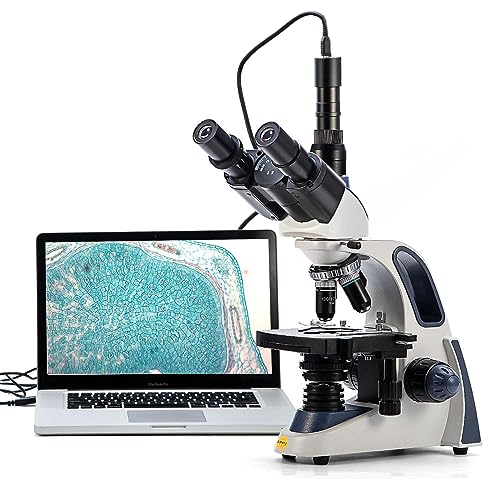
The SW380T is the classroom-friendly route into photomicrography, and this listing is the bundle that actually includes the 2MP camera, which the better-known camera-ready version leaves out. The Siedentopf trinocular head adjusts interpupillary distance without changing focus, a small mercy when a line of students shares one instrument, and the dedicated camera port sits above it for capture and live streaming to a computer. Four DIN achromatic objectives and two pairs of wide-field eyepieces give the familiar 40X-2500X spread, while the mechanical stage and precise coaxial focusing keep specimens centered as magnification climbs. It favors comfort and simplicity over optical refinement.
Specs
- Magnification: 40X-2500X
- Head: Siedentopf trinocular with dedicated camera port
- Eyepieces: wide-field 10X and 25X
- Objectives: four DIN achromatic objectives
- Stage: mechanical stage
- Focusing: coaxial coarse and fine, ultra-precise focusing system
- Camera: 2MP camera included in this bundle
Best for: Schools and home labs that want a camera in the box and a head that fits many users.
Watch out for: The common SW380T listing ships without any camera, so verify the listing you open is the camera bundle and not the camera-ready base model.
ASIN: B086VBBSMY
Which One Fits Your Situation
Preparing Figures for Papers and Printed Reports
Pick the AmScope T720Q-TP. Publication images are judged at the edges as much as the center, and its plan-achromatic infinity optics keep the full field in focus at once. The 5MP tablet camera gives enough resolution to crop for layout, and the touchscreen makes it easy to frame carefully before capturing. Even Koehler illumination also means fewer exposure corrections afterward.
Documenting Slides at a Shared Computer
Pick the OMAX M83EZ-C02. Its USB camera feeds straight into the lab computer, where captures can be named, measured and filed as part of the normal workflow. The 40X-2500X range covers everything from tissue sections to bacteria with the oil objective. If several users share the stand and head comfort matters more, the SWIFT SW380T bundle is the alternative to look at.
Showing Live Specimens to a Room
Pick the AmScope T490-HC2. The HDMI camera sends the live view to any monitor or television in the room and records stills and clips to a MicroSD card, so a class, clinic team or client sees exactly what the operator sees. There is no laptop to configure and no software session to start before the demonstration begins.
Photographing Living Cultures in Vessels
Pick the AmScope IN480TC-HD18-HDM. Upright microscopes cannot focus through a flask or culture dish properly, while this inverted stand was designed for exactly that geometry. The built-in monitor and SD capture keep the workflow inside the culture room, and the phase contrast objectives photograph unstained, living cells that brightfield alone would barely show.
Common Mistakes
- Judging a camera by megapixels alone, while ignoring the reduction lens that decides how much of the field the sensor records.
- Ordering a trinocular microscope described as camera-compatible and discovering the box holds no camera at all.
- Skipping calibration, then trusting software measurements that were never set against a 0.01mm stage micrometer slide.
- Photographing with the condenser iris fully open, which floods the image with glare and flattens stained detail.
- Treating the 2500X setting as extra detail, when beyond the resolving power of the oil objective it only enlarges the same image.
Frequently Asked Questions
What magnification do I actually need for photomicrography?
Most useful photomicrography happens between 40X and 1000X. Low settings frame tissue structure and colonies, mid settings suit cells and fibers, and the 100X oil objective at 1000X handles bacteria and fine detail. Settings above that, such as 2500X from stronger eyepieces, enlarge the image without adding resolved detail, so buy for objective quality rather than the largest number.
Is a trinocular head better than an eyepiece camera?
For regular photography, yes. A trinocular head gives the camera a dedicated port, keeps both eyepieces free for viewing, and usually matches focus between eyes and sensor more reliably. Eyepiece cameras replace one ocular, narrow the field and must be removed for normal binocular viewing. They make sense for occasional snapshots, not for a bench where capture is part of the daily routine.
Can these microscopes record video as well as still photographs?
Yes, every system here records video in some form. USB cameras capture through their computer software, the T490-HC2 writes clips to a MicroSD card while streaming over HDMI, and the IN480TC-HD18-HDM records 1080p video to SD media or a connected PC. Frame rates and file handling differ, so check the camera section of the listing if long recordings matter.
Do I need a computer to use the camera?
Not always. The OMAX and SWIFT USB cameras do need a computer for capture and control. The T490-HC2 works entirely alone with an HDMI screen and a memory card, the T720Q-TP carries its own tablet computer on the photo port, and the IN480TC-HD18-HDM runs from its built-in monitor with a mouse. Choose based on whether a computer already lives at your bench.
FAQ
What magnification do I actually need for photomicrography?
Is a trinocular head better than an eyepiece camera?
Can these microscopes record video as well as still photographs?
Do I need a computer to use the camera?
More from Amazon
Programs that pair well with the guide above. Offers and eligibility are set by Amazon and may change.
Free shipping on eligible items, Prime Video and more. Eligible new members can start with a free trial.
Start a Prime free trialAudiobooks and podcasts to listen to on the go. Eligible new members can start with a free trial.
Try Audible freeAd-free music streaming. Eligible new subscribers can start with a free trial.
Try Music Unlimited freeA free business account with business pricing and bulk-buying tools for work, shop or home office.
Create a business accountAs an Amazon Associate we earn from qualifying purchases.



Write Your Review
No reviews yet. Be the first to share your experience!