
Our Short List of 3

- Best for: Creators who want the strongest all-round 360 camera for daily shooting.
- 8K 360 video with 72MP 360 photos
- Twin 1/1.28-inch sensors with PureVideo AI low-light
- 4K60 single-lens mode
- User-replaceable lenses
- Best for: Shooters who want the largest sensors and the most built-in storage.
- Native 8K 360 video with 1-inch 360 imaging
- 120MP 360 photos
- 105GB built-in storage
- 100-minute 8K recording

- Best for: Travelers and vloggers who want 8K capture without the flagship outlay.
- 8K 360 video with 72MP 360 photos
- Twin 1/2-inch 48MP sensors
- 5.7K Active HDR 360 video
- 4K single-lens mode
All 5 Picks at a Glance
| Product | Specs | Action |
|---|---|---|
| Insta360 X5 |
| Check price on Amazon |
| DJI Osmo 360 |
| Check price on Amazon |
| Insta360 X4 |
| Check price on Amazon |
 GoPro MAX2 |
| Check price on Amazon |
 GoPro MAX |
| Check price on Amazon |
Key takeaways
- Compare the best 360 cameras for immersive video, with sharp stitching, stabilization and easy sharing for travel, vlogs and creators everywhere.
A 360 camera records everything around you at once, so you can decide later where the frame should point. That freedom changes how travel clips, bike rides, and family moments get captured, because nothing outside the lens gets missed while you shoot. The best models stitch the two fisheye views into one smooth sphere, keep horizons level while you move, and hand you simple tools for reframing the footage into a flat clip your friends can watch anywhere.
Choosing well means looking past the headline resolution and checking sensor size, battery life, waterproofing, and how the companion app handles editing on your phone. A camera that is awkward to carry or slow to export will sit in a drawer, no matter how sharp its footage looks on paper. This guide compares five current 360 cameras, from a pocketable stills specialist to rugged action models, so you can match the hardware to the way you actually shoot.
Quick Picks
As an Amazon Associate we earn from qualifying purchases
| Product | Best for | Key spec from title |
|---|---|---|
| Insta360 X5 | Flagship 8K action footage | 8K 360 video, 72MP photos |
| DJI Osmo 360 | Large-sensor image quality | 1-inch sensors, native 8K video |
| Insta360 X4 | Value 8K shooting | 8K 360 video, 135-minute battery |
| GoPro MAX2 | True 8K with replaceable lenses | True 8K spherical video, 29MP photos |
| GoPro MAX | Simple 5.6K capture | 5.6K spherical video, 16.6MP photos |
How to Choose
Resolution and Sensor Size
Resolution numbers only tell part of the story. A large sensor gathers more light, which keeps dim indoor scenes and evening streets cleaner, while a small sensor can smear fine detail even when the resolution figure looks impressive. Look for the sensor size in the specifications and weigh it next to the headline video figure. Eight thousand pixels spread across a full sphere still leaves a flat crop softer than a normal camera frame, so sensor quality matters more than the raw number. If you plan to crop tight reframed clips, favor the biggest sensor you can afford.
Stabilization and Stitching
Stabilization decides whether your footage feels smooth or seasick. Every camera here steadies the horizon electronically, but the quality of that correction varies, especially during running, riding, or windy hikes. Check whether horizon lock holds through steep tilts and quick turns, since that is where weaker systems drift. Stitching quality matters just as much: the seam where the two lenses meet should vanish in most scenes, though close objects and bright lights can still expose it. A camera with clean seams and firm horizon lock saves hours of fixing footage later.
Battery Life and Storage
A 360 camera burns through power faster than a normal action camera because it runs two sensors and stitches footage in real time. Compare the stated run time at your chosen resolution, not the longest figure on the box, and remember that cold weather and high frame rates shorten it further. Storage deserves the same attention: some models carry generous built-in memory, while others rely entirely on a memory card you must buy separately. Check the maximum card size the camera accepts and whether you can swap cards easily in the field.
Waterproofing, Size, and the App
Think about where the camera will actually go. A waterproof body survives rain, river crossings, and beach days without a housing, while a non-waterproof model needs protection the moment weather turns. Size matters too: a pocketable camera goes everywhere, and a heavier one stays home on casual days. Finally, weigh the companion app, because most 360 editing happens on a phone. Look for fast transfers, easy reframing, and simple sharing to the places you already post, since a clumsy app can turn a fun shoot into a chore.
The 5 Best Options
Insta360 X5
- Best for: Creators who want the strongest all-round 360 camera for daily shooting.
- 8K 360 video with 72MP 360 photos
- Twin 1/1.28-inch sensors with PureVideo AI low-light
- 4K60 single-lens mode
- User-replaceable lenses
Creators who want the strongest all-round 360 camera for daily shooting.
8K files are large, so keep spare memory cards and a charging routine handy.
The X5 sits at the top of Insta360’s lineup for good reason. Its twin 1/1.28-inch sensors capture 8K 360 video with noticeably cleaner low-light footage than the generation before it, and the lenses are user-replaceable, so a scratched lens no longer means a ruined camera. A large touchscreen makes framing simple, the body shrugs off rain and shallow water, and the app turns raw spheres into shareable clips with AI-assisted reframing. For creators who shoot daily in mixed light, this is the most complete package here.
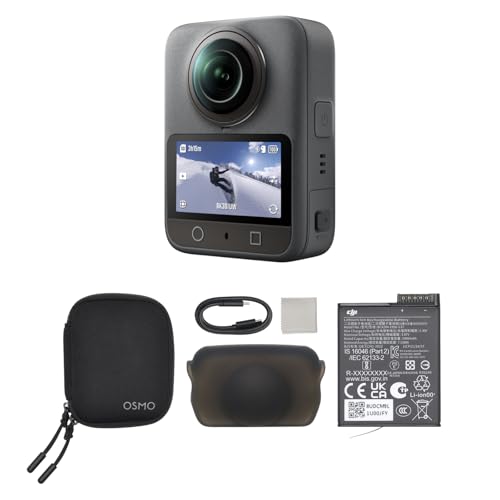
DJI Osmo 360
- Best for: Shooters who want the largest sensors and the most built-in storage.
- Native 8K 360 video with 1-inch 360 imaging
- 120MP 360 photos
- 105GB built-in storage
- 100-minute 8K recording
Shooters who want the largest sensors and the most built-in storage.
Native 8K clips demand a fast memory card and plenty of room on your phone for editing.
DJI’s first 360 camera arrives with serious hardware. Two 1-inch sensors record native 8K spherical video, and the 120MP photo mode pulls remarkable detail from still scenes. Built-in storage of 105GB means you can shoot a full day without hunting for a card, and the body stays compact enough for a jacket pocket. The magnetic mount swaps between accessories in seconds, and the app handles reframing with the polish DJI owners expect. It is the strongest choice here for image quality in a small package.
Insta360 X4
- Best for: Travelers and vloggers who want 8K capture without the flagship outlay.
- 8K 360 video with 72MP 360 photos
- Twin 1/2-inch 48MP sensors
- 5.7K Active HDR 360 video
- 4K single-lens mode
Travelers and vloggers who want 8K capture without the flagship outlay.
Low-light footage softens sooner than on the larger-sensor models above.
The X4 delivers most of the X5 experience at a friendlier level of commitment. Its 8K spherical video and 72MP stills hold up well in daylight, and the 5.7K Active HDR mode smooths tricky scenes with bright skies and dark shadows. Removable lens guards protect the glass on rough days, the battery runs for 135 minutes, and the touchscreen plus app make reframing quick even for first-time 360 shooters. If the flagship feels like more than you need, the X4 covers travel, cycling, and vlogging with room to spare.
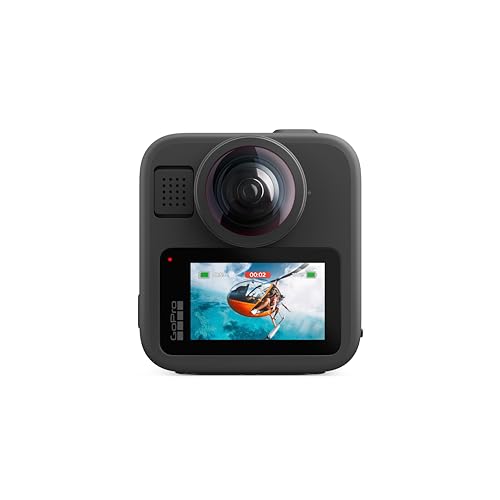
GoPro MAX2
- Best for: Filmmakers who reframe heavily and want the sharpest flat crops.
- True 8K spherical video with 29MP 360 photos
- Easy replaceable lenses
- HyperSmooth stabilization
- 6 microphones
Filmmakers who reframe heavily and want the sharpest flat crops.
The body is the heaviest here, so pair it with a sturdy mount for long shoots.
The MAX2 is GoPro’s answer to creators who want maximum reframing room. True 8K spherical video and 29MP stills give flat crops far more detail than the original MAX, and the lenses are now replaceable, which removes the biggest worry of the earlier model. HyperSmooth keeps motion steady, six microphones capture spatial audio, and the touchscreen makes switching between 360 and traditional modes painless. It is heavy for its size, but for filmmakers who reframe aggressively, the extra resolution earns its place.
GoPro MAX
- Best for: Beginners who want an easy, affordable way into 360 shooting.
- 5.6K30 spherical video with 16.6MP 360 photos
- Touchscreen
- Waterproof body
- 1080p live streaming
Beginners who want an easy, affordable way into 360 shooting.
Cropped flat clips lose detail faster than on the 8K models in this guide.
The original MAX remains a sensible pick for anyone entering 360 shooting. Its 5.6K spherical video and 16.6MP stills will not match the newer 8K models for cropped detail, yet the footage still looks clean on phones and social feeds. The touchscreen is simple to learn, the body is waterproof without a housing, and live streaming in 1080p works straight from the camera. For casual trips, family outings, and first experiments with reframing, the MAX covers the basics with the least fuss of any camera here.
Which One Fits Your Situation
You film travel and vlogs every week
Pick the Insta360 X5 or the DJI Osmo 360. Both handle mixed light well, survive rain, and export reframed clips quickly from a phone. The X5 wins on battery life and low-light polish, while the Osmo 360 wins on built-in storage and still-photo detail. Either one rides comfortably in a jacket pocket and keeps up with a full day of walking, eating, and exploring.
You ride, run, or shoot action sports
Choose the GoPro MAX2 or the Insta360 X4. The MAX2 gives the sharpest reframed crops for fast action, while the X4 is lighter and easier to mount on a helmet or handlebar. Both offer strong stabilization and waterproof bodies, so rain and splashes will not cut a session short. Add lens guards and a spare battery before a long ride.
You want the best still photos
Take the DJI Osmo 360. Its 120MP photo mode and 1-inch sensors capture far more still detail than any other camera here, and the 105GB of built-in storage holds thousands of frames without a card. The X5 is the backup choice if you also shoot a lot of video, since its low-light photos stay cleaner after sunset.
You are trying 360 for the first time
Go with the GoPro MAX or the Insta360 X4. The MAX is the simplest camera here, with a friendly touchscreen and forgiving footage, while the X4 adds 8K capture and a modern app without much extra complexity. Both forgive beginner mistakes and teach the reframing workflow quickly, so you can decide later whether a flagship upgrade is worth it.
Common Mistakes
- Buying for the biggest resolution number while ignoring sensor size, which shapes low-light quality far more.
- Forgetting that 8K spheres need large memory cards, fast transfer speeds, and a phone with room for editing.
- Shooting with dirty lenses, since a single smudge sits right in the stitch line and ruins the sphere.
- Mounting the camera where a handlebar, helmet edge, or your own hand blocks one lens.
- Skipping a lens guard or protective case, then learning how easily an exposed fisheye lens scratches.
Frequently Asked Questions
Do 360 cameras need special editing software?
Most 360 cameras ship with a companion app that handles reframing, horizon leveling, and exporting flat clips, so you can edit on a phone without extra software. Desktop apps from the same makers offer finer control for longer projects. The workflow feels unusual at first, but framing after the shoot soon becomes second nature.
Can a 360 camera replace a normal action camera?
Yes, for many uses. Every camera here also records a single-lens flat view, so it works like a normal action camera when you want it to. The trade-off is bulk and battery life: a dedicated action camera is smaller and runs longer. If you shoot mostly flat video, a normal action camera may suit you better.
How much storage does 360 video use?
A lot. 8K spherical footage fills cards far faster than normal 4K video, and a long day of shooting can swallow a large card before lunch. Carry at least one spare card, offload footage each evening, and favor models with generous built-in storage if you hate managing cards on the move.
Are 360 cameras waterproof?
Most modern 360 cameras are waterproof to a useful depth without a housing, which covers rain, pools, and shallow dips. Check the depth figure for your model before taking it deeper, since snorkeling and diving need a dedicated housing. Always dry the lenses gently after water use, because droplets left on the glass show up clearly in the stitch.
FAQ
Do 360 cameras need special editing software?
Can a 360 camera replace a normal action camera?
How much storage does 360 video use?
Are 360 cameras waterproof?
More from Amazon
Programs that pair well with the guide above. Offers and eligibility are set by Amazon and may change.
Free shipping on eligible items, Prime Video and more. Eligible new members can start with a free trial.
Start a Prime free trialAudiobooks and podcasts to listen to on the go. Eligible new members can start with a free trial.
Try Audible freeAd-free music streaming. Eligible new subscribers can start with a free trial.
Try Music Unlimited freeA free business account with business pricing and bulk-buying tools for work, shop or home office.
Create a business accountAs an Amazon Associate we earn from qualifying purchases.
Write Your Review
No reviews yet. Be the first to share your experience!