
Key takeaways
- Compare the best camera batteries for Canon, Sony, Nikon and Fujifilm cameras, with maker-rated capacities, compatibility checks and charging guidance.
A spare battery is the cheapest insurance a photographer can carry. Mirrorless cameras draw power constantly for their electronic viewfinders and rear screens, video recording drains a pack far faster than stills, and cold weather shortens the runtime of any lithium-ion cell. When the battery icon starts blinking in the middle of a wedding, a landscape shoot at dawn, or a family event, there is no workaround except a charged replacement in your bag.
This guide covers replacement and extra batteries for the four most common mirrorless and DSLR battery families: Canon, Sony, Nikon, and Fujifilm. Four picks are the camera makers’ own packs, which guarantee full communication with the camera. The fifth is a reputable third-party option that adds direct USB-C charging for Fujifilm shooters. Every pick below is tied to one exact battery designation, because with camera batteries the designation matters more than anything else.
As an Amazon Associate, we earn from qualifying purchases.
Quick answer
Start with the battery designation your camera maker lists for your exact camera model, then buy that pack. The Canon LP-E6NH, Sony NP-FZ100, Nikon EN-EL15c, and Fujifilm NP-W235 are the original maker packs for their systems and the safest spares. Fujifilm shooters who travel light can consider the SmallRig NP-W235 USB-C battery, which charges directly from a USB-C cable. Match the designation first and compare maker-rated capacity second.
How to choose
Match the exact battery designation. Buy only the battery model your camera maker lists as compatible with your camera. Designations such as LP-E6, NP-FZ100, EN-EL15c, and NP-W235 describe the physical shape, contacts, and electronics of the pack, and a battery from the wrong family will not fit or will not communicate with the camera, even when it looks similar. Check the designation printed on your current battery and in your camera manual before ordering, and match it character for character.
Read capacity figures as maker ratings. Capacity in milliamp hours (mAh) and energy in watt hours (Wh) are figures each maker publishes for its own packs, and shot counts are ratings the camera makers publish for specific camera models under standard test conditions. Real runtime depends on screen and viewfinder use, video recording, wireless features, and temperature, so treat every capacity and shot-count figure in this guide as the maker’s rating rather than a promise. Figures are only roughly comparable between brands, because test conditions differ.
Weigh original packs against third-party packs. An original maker pack guarantees that the camera reads the remaining charge correctly and that firmware updates will not affect it. Reputable third-party brands publish their own capacity ratings and design their packs to communicate with the camera, but the camera makers themselves recommend their own batteries, and a third-party pack is covered by its own maker’s warranty rather than the camera maker’s. Decide which trade-off suits your budget and how you shoot.
Charge and store packs the way the makers direct. Charge only with a charger the battery maker approves for that pack, whether that is the camera maker’s cradle charger, in-camera USB charging on models that support it, or a USB-C port built into the battery itself. For storage, follow maker guidance: keep packs at a partial charge in a cool, dry place, with terminal covers fitted so the contacts cannot touch metal objects in your bag.
Retire damaged packs safely. A battery that is swollen, cracked, leaking, or unusually hot should be removed from service immediately. Dispose of swollen or damaged batteries according to your local rules for lithium-ion waste, and never put them in household trash where local rules prohibit it. Tape exposed terminals before taking a retired pack to a collection point.
Canon LP-E6NH
The LP-E6NH is Canon’s own high-capacity pack for its current full-frame mirrorless line and its recent DSLRs, and it remains the default spare for Canon shooters who want zero compatibility questions.
Specs
- Battery type: Rechargeable lithium-ion pack, per Canon
- Designation: LP-E6NH
- Voltage: 7.2 V, per Canon
- Capacity: 2130 mAh, 16 Wh, per Canon
- Compatibility: Canon lists the EOS R5, R6, R6 Mark II, R7, R5 C, EOS R, 5D Mark IV, 5D Mark III, 5Ds, 5Ds R, 6D, 6D Mark II, 7D Mark II, 90D, 80D, 70D, and 60D among the cameras using this pack
- Charging: Canon LC-E6 series chargers, plus in-camera USB charging on camera models that support it, per Canon
Who it fits / who should skip
It fits Canon shooters who want the pack Canon designed for their camera, with accurate remaining-charge display and full support for in-camera charging where the body offers it. Canon also states the LP-E6NH works in cameras designed for the earlier LP-E6 and LP-E6N, so it doubles as an upgrade spare for older bodies. Skip it if your camera takes a different designation, such as the smaller LP-E17 used by Canon’s compact mirrorless models, because that family is a different size and shape entirely.
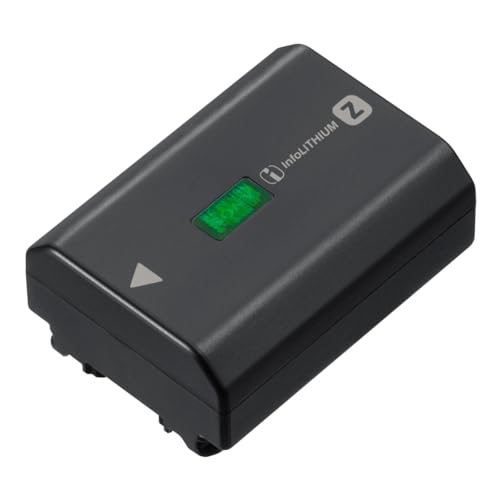
Sony NP-FZ100
Sony’s Z-series pack is the single battery behind almost the entire current Alpha full-frame line, which makes it one of the easiest spares to justify: one designation covers many bodies.
Specs
- Battery type: Rechargeable lithium-ion InfoLITHIUM Z-series pack, per Sony
- Designation: NP-FZ100
- Voltage: 7.2 V, per Sony
- Capacity: 2280 mAh, 16.4 Wh, per Sony
- Compatibility: Sony lists the a7 III, a7 IV, a7R III, a7R IV, a7R V, a7S III, a7C, a7C II, a7CR, a9, a9 II, a9 III, a1, a6600, a6700, FX3, FX30, and ZV-E1 among the cameras using this pack
- Charging: Sony BC-QZ1 charger, plus in-camera USB charging on camera models that support it, per Sony
Who it fits / who should skip
It fits Alpha shooters who shoot long days, record video, or work events where swapping mid-session is routine, and who want Sony’s own charge reporting on screen. Skip it if your Sony camera uses the smaller NP-FW50, which includes the a6000-series bodies and the ZV-E10; that is a different, smaller designation and the two packs are not interchangeable.
Nikon EN-EL15c
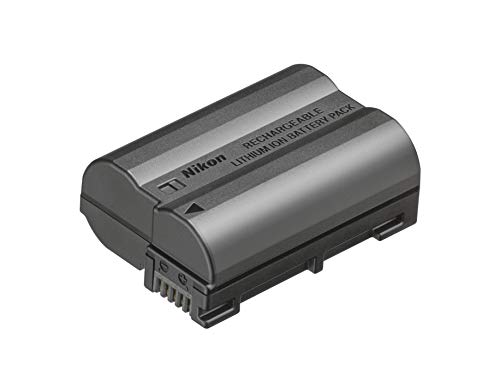
Nikon’s EN-EL15c is the current version of the long-running EN-EL15 family, covering most Z-series mirrorless bodies and a wide range of D-series DSLRs with one shared spare.
Specs
- Battery type: Rechargeable lithium-ion pack, per Nikon
- Designation: EN-EL15c
- Voltage: 7.0 V, per Nikon
- Capacity: 2280 mAh, 16 Wh, per Nikon
- Compatibility: Nikon lists the Z8, Z7II, Z6II, Z7, Z6, Z5, and Zf mirrorless cameras, plus D850, D780, D750, D7500, D7200, D500, and earlier EN-EL15-family DSLRs among the cameras using this pack
- Charging: Nikon MH-25 series chargers, plus in-camera USB charging on Z-series models that support it, per Nikon
Who it fits / who should skip
It fits Nikon shooters running a mixed kit of Z mirrorless and D-series DSLR bodies, because the same spare serves both. The EN-EL15c is also the version Nikon specifies for in-camera USB charging on supported Z bodies, which matters if you top up from a power bank while traveling. Skip it if your Nikon uses a different family, such as the EN-EL25 in the Z50 and Zfc or the EN-EL18 series in flagship bodies; those designations are different sizes.
Fujifilm NP-W235
The NP-W235 is Fujifilm’s high-capacity pack for its current X-series flagships and GFX medium-format bodies, and it holds roughly half again the capacity Fujifilm rated for the older NP-W126S family.
Specs
- Battery type: Rechargeable lithium-ion pack, per Fujifilm
- Designation: NP-W235
- Voltage: 7.2 V, per Fujifilm
- Capacity: 2200 mAh, per Fujifilm
- Compatibility: Fujifilm lists the X-T5, X-T4, X-H2, X-H2S, X-S20, GFX100S, GFX 50S II, and GFX100 II among the cameras using this pack
- Charging: Fujifilm BC-W235 dual charger, plus in-camera USB charging on camera models that support it, per Fujifilm
Who it fits / who should skip
It fits Fujifilm shooters with an X-T4 or newer flagship body who shoot video or long event days and want Fujifilm’s own pack with correct charge display. Skip it if your Fujifilm body uses the NP-W126S, which includes the X-T3, X-T30, and X100V generation; the NP-W235 is physically larger and does not fit those cameras.
SmallRig NP-W235 USB-C Battery (4266)
SmallRig’s take on the NP-W235 format keeps the same designation and fit, then adds a USB-C port on the battery itself, so the pack can charge from a cable and power bank without carrying Fujifilm’s cradle charger.
Specs
- Battery type: Rechargeable lithium-ion pack, per SmallRig
- Designation: NP-W235 format, model 4266
- Voltage: 7.2 V, per SmallRig
- Capacity: 2400 mAh, 17.28 Wh, per SmallRig
- Compatibility: SmallRig lists Fujifilm cameras that use the NP-W235, including the X-T4, X-T5, X-H2, X-H2S, and GFX100S families
- Charging: Built-in USB-C port for direct cable charging, and it can also be charged in a dedicated NP-W235 charger, per SmallRig
Who it fits / who should skip
It fits Fujifilm shooters who travel with a power bank and want to charge a spare in a hotel room, car, or camera bag without packing a separate charger, and its maker-rated capacity figure is higher than Fujifilm’s rating for the original pack, though that figure is SmallRig’s own rating. Skip it if you prefer the camera maker’s own battery and warranty coverage, or if your camera uses any designation other than NP-W235.
Comparing the five
Four of these five packs are the camera makers’ own, and their maker-rated capacities sit in a narrow band between 2130 mAh and 2280 mAh, so raw capacity alone rarely decides the purchase. The real differences are the designation your camera demands, how the pack charges, and who stands behind it. Canon, Sony, Nikon, and Fujifilm each support in-camera USB charging on their newer bodies, which softens the need for a cradle charger, while the SmallRig moves the charging port onto the battery itself at the cost of leaving the maker’s ecosystem. Buy the designation first, then choose between the original pack and the USB-C alternative where one exists.
FAQ
Can I use a third-party battery with a higher mAh figure than the original?
Only when the designation matches your camera exactly and the battery maker lists your camera as compatible. A higher mAh figure is that maker’s own rating for its pack, measured under its own conditions, so it does not guarantee proportionally longer shooting. If your camera displays a warning with a third-party pack, follow the camera maker’s guidance for your model.
How many spare batteries should I carry?
That depends on how you shoot. Stills-only shooters often finish a day on one pack plus a spare, while video recording, heavy viewfinder use, and cold weather all increase consumption, based on the camera makers’ published ratings and guidance. A practical approach is one spare for casual days and two for paid work, weddings, or travel where recharging is uncertain.
How should I store spare camera batteries?
Follow the battery makers’ guidance: store packs at a partial charge rather than completely full or completely empty, keep them in a cool, dry place, and fit the terminal cover so contacts cannot short against keys or coins in your bag. Recheck stored packs every few months and top them up if they have self-discharged deeply.
When should I replace a camera battery?
Replace a pack when it no longer holds a useful charge, when the camera reports errors with it, or immediately if it becomes swollen, cracked, or damaged. Retired lithium-ion packs go to battery collection points under local rules, never in household trash where that is prohibited, and taping the terminals first is the standard precaution.
Final verdict
For most photographers, the best spare camera battery is simply the original pack your camera maker sells for your body: the Canon LP-E6NH, Sony NP-FZ100, Nikon EN-EL15c, or Fujifilm NP-W235, matched exactly to the designation printed on the battery you already own. Those four remove every compatibility and communication doubt. Fujifilm shooters who would rather charge from a USB-C cable than carry a cradle charger have one well-supported alternative in the SmallRig NP-W235 USB-C battery. Whichever route you take, buy the designation first, charge with equipment the battery maker approves, and store your spares partially charged and covered.
Product and ASIN Reference
| Product | ASIN |
|---|---|
| Canon LP-E6NH | B08CNF4T8Z |
| Sony NP-FZ100 | B071CLKMRT |
| Nikon EN-EL15c | B08DDKS7DV |
| Fujifilm NP-W235 | B0851TVR2K |
| SmallRig NP-W235 USB-C Battery (4266) | B0C77W2R3W |
More from Amazon
Programs that pair well with the guide above. Offers and eligibility are set by Amazon and may change.
Free shipping on eligible items, Prime Video and more. Eligible new members can start with a free trial.
Start a Prime free trialAudiobooks and podcasts to listen to on the go. Eligible new members can start with a free trial.
Try Audible freeAd-free music streaming. Eligible new subscribers can start with a free trial.
Try Music Unlimited freeA free business account with business pricing and bulk-buying tools for work, shop or home office.
Create a business accountAs an Amazon Associate we earn from qualifying purchases.
Write Your Review
No reviews yet. Be the first to share your experience!